
India's leading listed real estate developers are increasingly focusing on pan-India expansion, diversifying beyond their traditional home markets into high-demand residential areas like MMR, NCR, Bengaluru, Hyderabad, Pune, and Chennai to tap broader housing demand and reduce reliance on single-city market cycles.

Escalating geopolitical tensions in West Asia are prompting investors with exposure to Dubai's real estate market to reassess their portfolios. And, in this rejig, India is emerging as a stable destination for capital investment and long-term growth.

Amateur golfer Lavanya Gupta surged ahead of Jasmine Shekar to claim the lead after the second round of the Hero Women's Pro Golf Tour in Gurugram, with Durga Nittur making a significant leap into third place.

Eugenio Chacarra leads the Hero Indian Open, aiming for back-to-back wins, while Casey Jarvis trails closely, seeking his third DP World Tour title. Several Indian players face a tough weekend after a disrupted second day.

The government's Budget announcements providing tax holiday for data centres, setting up of city economic regions (CERs) and funding to improve infrastructure in Tier-II and -III cities may give an indirect boost to India's realty sector, said industry executives.

India's leading real estate developers are accelerating their push into plotted development, a segment once dominated by unorganised players but now reshaped by branded offerings, faster cash flows and evolving buyer preferences. This strategic shift is visible across markets such as Bengaluru, Chennai, Hyderabad, Gurugram, peripheries of the Mumbai Metropolitan Region (MMR) and even Tier-II cities.

Interest in green living is rising, with clean air and open spaces becoming key selling points for residential projects, particularly as Indian cities struggle with deteriorating air quality.
Top real estate developers reported healthy presales growth in the second quarter of FY26, aided by a steady pipeline of new project launches. While overall housing momentum across major Indian cities moderated during the quarter, listed players remained relatively insulated.

Developers are entering one of the busiest construction cycles, with the top four firms planning launches worth Rs 1.13 trillion over the near to medium term, even as execution faces pressure from approval delays, labour shortages, rising costs, and contractor capacity limits across the industry.

India's top listed real estate developers - DLF, Lodha Group, Prestige Estates, and Oberoi Realty, excluding Godrej Properties - reported strong presales growth in the first quarter (Q1) of 2025-26 (FY26), even as earnings showed a mixed trend. According to Nomura, the top five developers - DLF, Lodha, Prestige, Oberoi, and Godrej - recorded a cumulative 59 per cent year-on-year (Y-o-Y) growth in presales.

Affordable homes, priced under Rs 40 lakh per unit, may not be attractive anymore, not just for developers but also for investors, with the segment seeing a 26 per cent price rise over three years since 2022 versus 40 per cent returns from luxury homes priced Rs 1.5 crore and above.

High-street rentals continue to outpace those of malls, as retailers focus on prime locations and are willing to pay a premium for visibility. Between 2021 and 2025, rental values on prime high street have grown 7-15 per cent annually, driven by strong consumption density and limited new supply, even outpacing grade A malls, which grew by 5-8 per cent, according to Anarock.

Currently, India has five publicly listed Reits: Brookfield India Real Estate Trust, Embassy Office Parks Reit, Mindspace Business Parks Reit Nexus Select Trust, and Knowledge Realty Trust.
India's real estate investment trust (Reit) sector is set for robust expansion, with at least one new Reit expected to enter the market each year over the next three-five years. This growth trajectory builds on rising occupancies, surging leasing activity, and increasing investor interest.

India's top 9 cities are likely to witness a 4 per cent decline in housing sales in the quarter ending September to over 1 lakh units on lower demand in Mumbai region and Pune, according to PropEquity. Real estate data analytics firm PropEquity on Sunday released data of primary residential market for July-September, which is generally considered as a weak quarter because of monsoon season and inauspicious Shraadh period.

Part-I of this three-part series dives into Delhi-NCR's SPR, Sohna, Dwarka Expressway, and Jewar Airport leading the charge.

India's two corporate giants Tata Group and Mukesh Ambani owned Reliance Group have booked space in DLF Ltd's malls for rolling out their retail ventures.
The DLF group has deferred the Singapore listing of DLF Office Trust, the real estate investment trust of DLF Asset, till the market condition improved, said sources close to the Gurgaon-based real restate group. DLF Asset has received investments worth $600 million from hedge fund DE Shaw and Lehman Bothers. DLF may now raise Rs 2,000 crore through private trusts or a private placement by March end.
Real estate giant DLF announced on Tuesday its tie-up with US-based financial player Prudential Financial, Inc for a foray in life insurance business and said the two partners will invest about Rs 10 billion over the next ten years in the venture.
Debt-ridden realty player DLF on Tuesday said it will sell more land and wind power business this fiscal to raise Rs 1,900 crore (Rs 19 billion) and lowered the sales figure for flats.

These trusts are being registered under a new framework.

Developers based outside Mumbai are making a beeline for India's largest real estate market through redevelopment projects. These include Delhi-based DLF, Bengaluru-based Prestige Estates and Puravankara, Pune-based Kolte-Patil Developers and Vascon Engineers, and Hyderabad-based Ramky Estates.

Leading theatre chain PVR Ltd announced a cash-and-stock deal to buy out realtor DLF group's national multiplex chain, DT Cinemas.

These are the top buyers of the scrapped electoral bonds, the data for which was released by the Election Commission on Thursday.

Office space owners are looking at good times ahead as rentals are expected to rise due to demand for Grade A office spaces outpacing supply that has been sluggish due to construction delays, long gestation periods and developers' interests shifting to residential.

Data centres are increasingly becoming a key part of the real estate landscape, as reality firms - with rich expertise in land acquisition, construction and dealing with government approvals - are seeing them as opportunities to build long-term assets with continuous revenue flow.

The exchange had earlier said that DLF would move out from Group A.
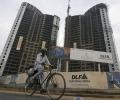
Encouraging results for the fourth quarter of the 2022-23 financial year (Q4FY23) have led to a big surge in the share price of DLF. The realty major closed FY23 with Rs 15,000 crore (up 107 per cent year-on-year or YoY) of pre-sales, leading to cash generation of Rs 2,500 crore (up 14 per cent YoY) and reduced net debt by Rs 1,960 crore YoY. The launch of The Arbour project in Q4FY23 alone drove sales of Rs 8,000 crore in the quarter.
A complainant has alleged that he was duped of his land worth Rs 34 crore by the DLF Group and following a direction by the Delhi high court, Sebi has ordered a full-fledged probe into the complaint.

'In the past six months, capital markets have seen a dip, and realty is struggling. The stock-market investor will be cautious of putting that investment in real estate when there may be a slowdown coming.'

Realty major DLF's chairman Rajiv Singh remains the wealthiest Indian real estate entrepreneur with a wealth of Rs 59,030 crore, according to GROHE-HURUN India. With a wealth of Rs 42,270 crore, Mangal Prabhat Lodha and his family of Mumbai-based Macrotech Developers (Lodha Group) is at the second position. Arjun Menda & family of Bengaluru-based RMZ Corp debuted at the third position on the list, with a wealth of Rs 37,000 crore.
In mid-2020, when Kushal Pal Singh, the undisputed king of India's vast real estate market, relinquished the top post at the country's largest realtor, he left behind an empire that is best compared to the Greek myth of the Phoenix. Once the leader of Delhi's organised real estate market, DLF's steep decline in the 1970s and its majestic rise since has often been cited as a business resurrection story. Now, a year after his departure from the helm of affairs, history seems to be repeating itself at the real estate major. In the 1970s, it was the government prohibitions that had forced DLF to venture into uncharted territory; some five decades later, the Delhi-headquartered firm has set its eyes on another growth trajectory that holds immense potential.

The classification is based on several factors.
The company has already booked Rs 5,450 crore (Rs 54.5 billion) revenue from sale of 5 million sq ft it has sold to DAL. DLF on Tuesday clarified to the exchanges that it had been looking at various options from time to time but no definite option had been presented to the board so far for its consideration.

DLFknowingly suppressed material facts: Sebi

It was an individual complainant, seeking action against Rs 34 crore (Rs 340 million) he was allegedly duped, and "sham transactions" involving three 'housewives' that has led to regulator Sebi coming hard on the country's biggest real estate developer DLF and its top executives.

Anmol Singh Jaggi and Puneet Singh Jaggi, once hailed as rising stars in India's clean energy sector, are now facing serious regulatory action.
Real estate developers are hoping that the slew of tax concessions announced in Union Budget 2025, set to take effect this financial year, will spur demand for affordable and mid-segment housing, even as the broader housing market shows signs of fatigue.

Ambani and Adani account for a fifth of the net worth of all billionaire promoters in the country and half the combined net worth of the top 10.
